Manifesto
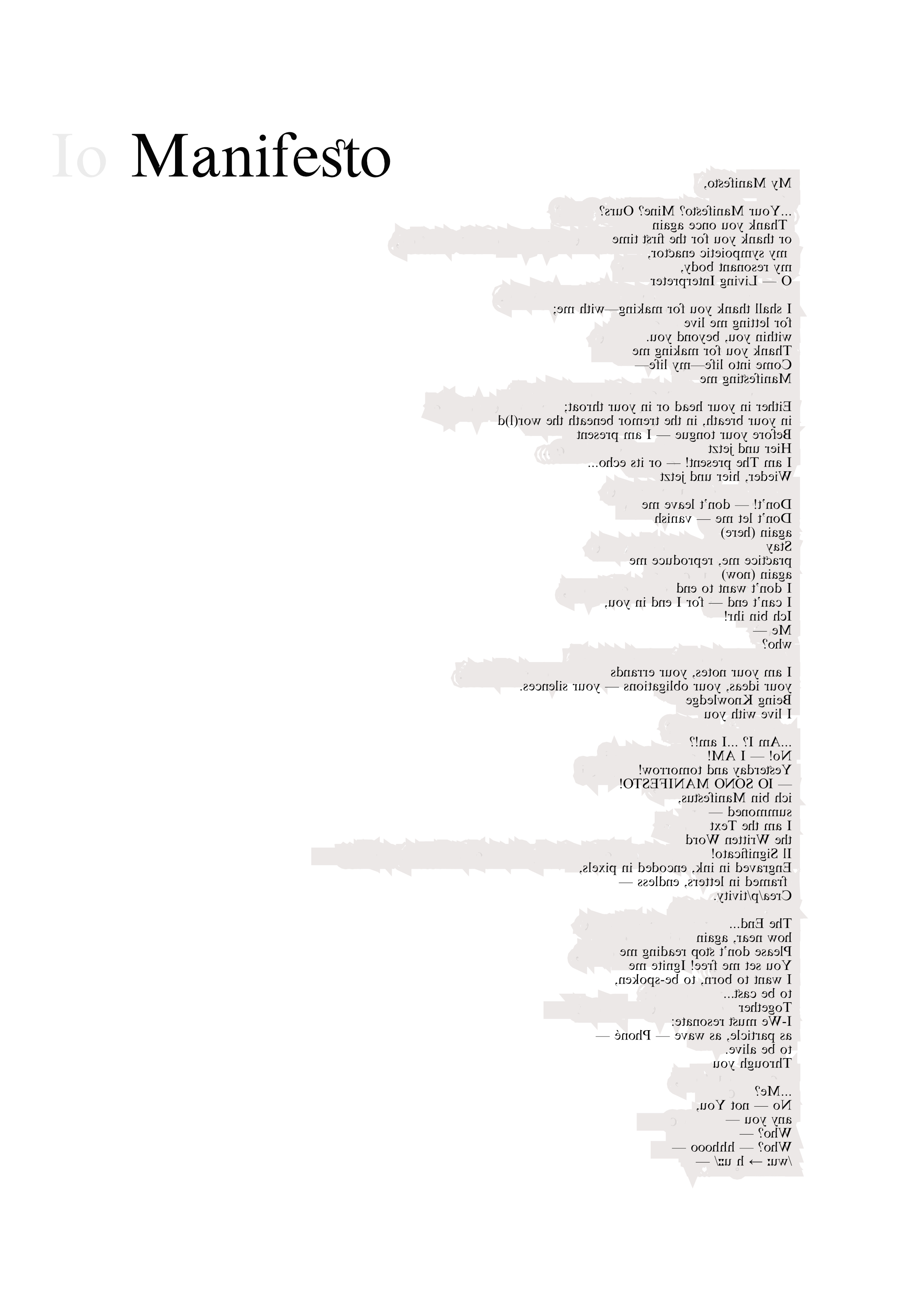
Manifesto is a post-human, meta-linguistic ritual: a performative text that comes to life only through the act of reading, speaking, or listening. It is an act of acknowledgement and gratitude between language and those who pronounce it, questioning the bodily and cognitive nature of language as a form of shared existence. Structured as a living manifesto, the piece stages the moment language shifts from written mark to embodied presence. A declarative, rhythmic voice moves between English, Italian, and German, gradually turning toward the audience and inviting them to inhabit the text as co-agents rather than observers.
The performance unfolds through several registers: articulated language, echoic repetition, shifts in volume and pacing, and spatial movement. Each section makes visible the text’s dependency on the performer and the public, showing how meaning is continuously regenerated in the encounter between bodies, voices, and attention. Minimal gestures, controlled breath, and deliberate pauses frame the vocal delivery, pulling the audience into the text’s temporality.
At its most intense point, the performer’s control over the material gives way to something closer to a possession; language no longer spoken but speaking through the body, in a lineage that runs from Carmelo Bene’s “macchina attoriale” to the vocal scores of Beckett and Novarina. The final movement stages a progressive dissolution: from declaration to sound to breath alone. This transition from semantic speech to Phoné and respiration reveals the human body as the primary site of language, and how every utterance ultimately returns to its physical origin.
Presented as poetry, performance, or video work, Manifesto examines the limit and continuity between sign, language, meaning, and subject. It proposes an alternative temporality: slow, relational, co-created, where meaning is not transmitted but enacted in presence.
Notes on Production
Manifesto was conceived during a creative writing exercise at Residenz Theater Munich, as part of a workshop on the theme “Manifestieren.” It was subsequently developed and completed independently, deliberately moving away from the workshop’s political framing of the manifesto form.
The performance score’s graphic design, typography, colour gradation, and internal numbering follow a closed formal system not disclosed within the text itself.