Referencing (Giacomelli, 2025)
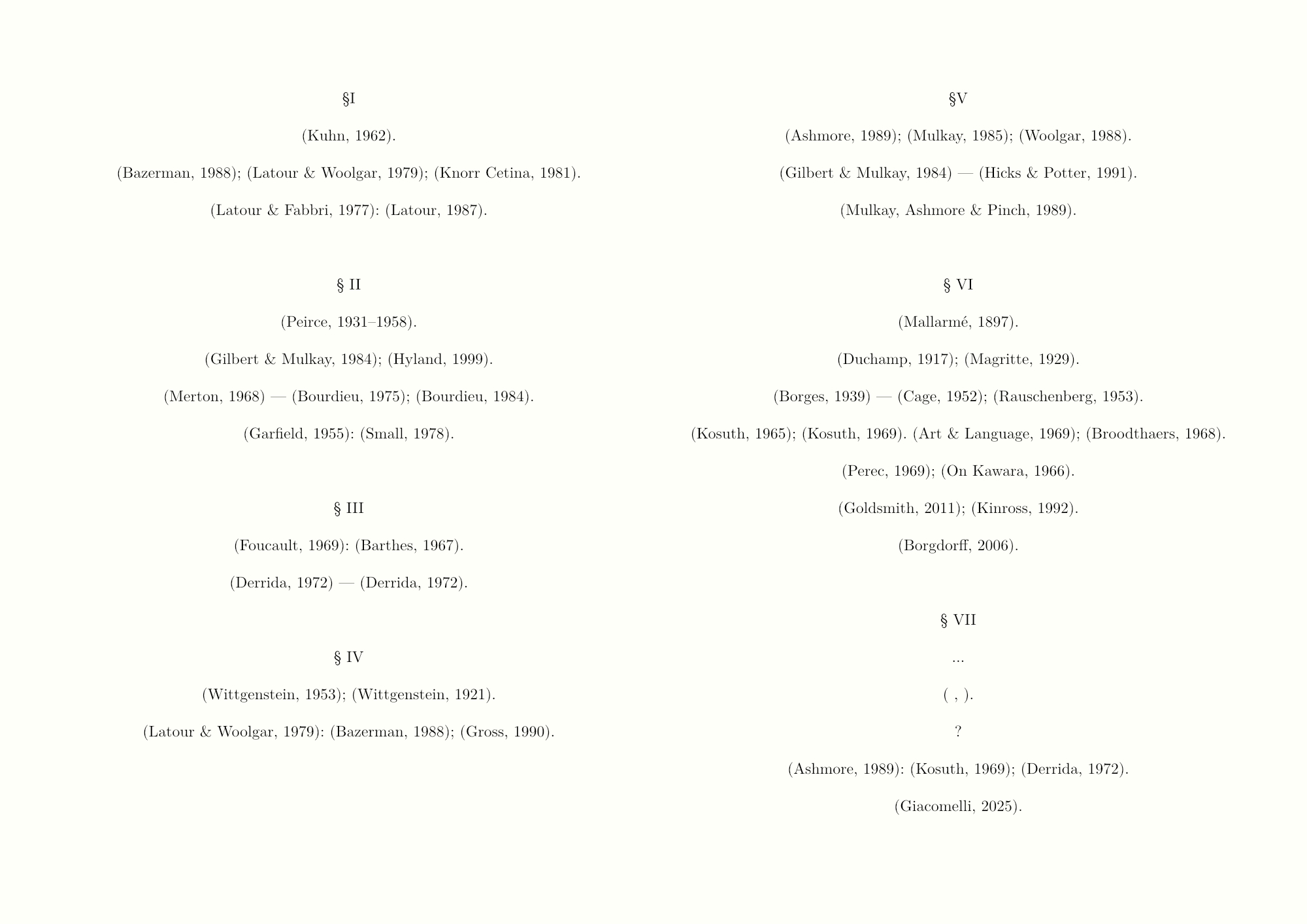
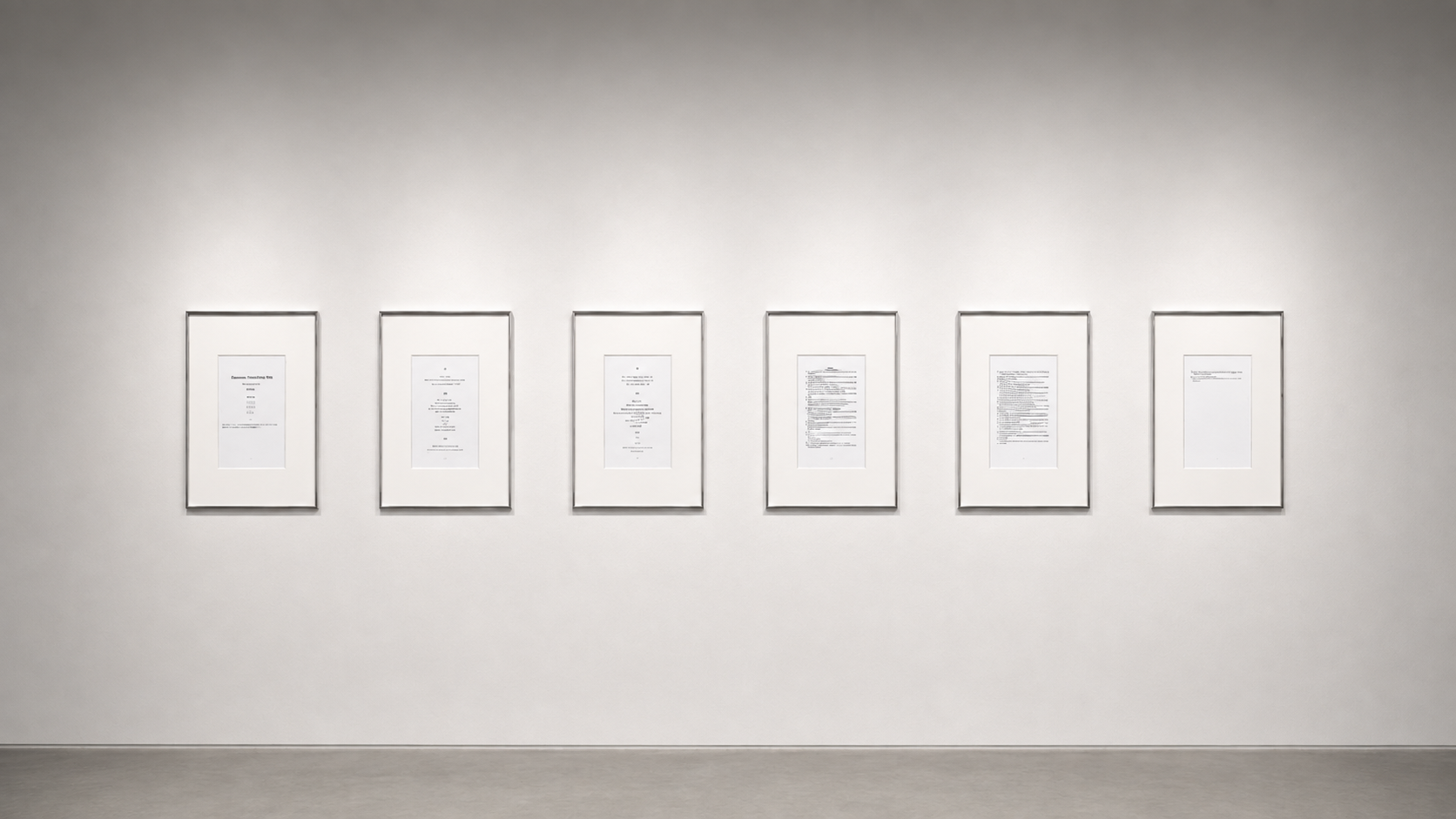
Referencing (Giacomelli, 2025) is an academic-artistic essay composed entirely of parenthetical citations, punctuation, and scholarly formatting, without a single word of prose. The work argues that the parenthetical citation, (Surname, year), operates as a device of epistemic delegation: a gesture that can replace argumentation while performing the appearance of rigour. The essay carries this logic to its breaking point, becoming at once a critique of citation practices in academic writing and its radical embodiment: a paper that is all apparatus and no body, an argument that outsources itself entirely and closes by citing itself.
A second document accompanies the essay: a critical paratext structured as a reading key, meant to be read alongside the work rather than in place of it. The two texts function as complementary operations: one enacts its argument through form alone, made entirely of citations and punctuation; the other translates that form back into discursive prose. The tension between them is constitutive of the project.
The essay stages a thought experiment: can a sequence of parenthetical references, minimally structured by punctuation, constitute an argument? In contemporary academic writing, a significant part of what counts as argument is already delegated to a network of citations. By removing prose from the body of the text, the essay makes this delegation visible, tying it to authorities, metrics, and disciplinary canons, and links it to Derridean iterability: (Surname, year) functions as a repeatable sign whose authority does not depend on any particular reading of the cited text.
Like the papers it cites, the essay is structured in two parts, a body and an abstract. The abstract takes the subtraction further: where the body retains author names and dates, the abstract retains only punctuation, the syntactic skeleton of an argument with all referential content removed. The project thus operates across three levels of progressive abstraction: the reading key, which preserves full discursive prose; the body, which preserves citations and punctuation; and the abstract, which preserves punctuation alone. Each level enacts a further extraction, in the etymological sense, of form from matter.
The work draws on three intersecting traditions:
- The rhetoric and sociology of scientific knowledge, which shows that facts and theories are produced and stabilised through writing, inscription, and citation practices.
- Deconstructive and semiotic accounts of citationality and iterability, which analyse how signs function through repetition in new contexts.
- Reflexive and conceptual practices in both STS and contemporary art, where form interrogates its own conditions and institutional framings.
The reading key performs three functions: it decodes the punctuation system as an argumentative syntax; it glosses the inferential moves encoded in the ordering of citations; and it positions the work within these academic and artistic lineages.
Both the essay and the reading key are available to download from the Publications page of this site.