Studies for Another Fucking Universal Conlang
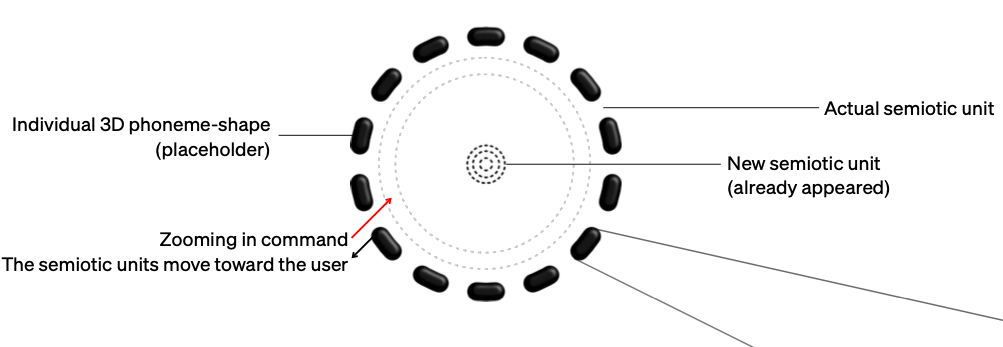
This project is an ongoing exploration into the creation of an experimental constructed language (conlang), situated at the intersection of artistic practice and scholarly research. This conlang aims to establish a semiotic-palindromic system in an immersive-concentric structure.
The goal is to develop a language system that is coherent in both its theoretical premises and its practical application; one that functions simultaneously as a work of art, a linguistic experiment, and a critical commentary on the very possibility of universal communication. A language that can be spoken and understood by all and that is coherent (to some extent) with respect to how human beings exist in the World.
As this endeavour remains a work in progress, the complexities and contradictions that arise are not treated as obstacles but acknowledged as constitutive of the inquiry itself: a language that claimed to be free of contradiction would, by that very claim, betray the processual and situated nature of all semiotic systems.
The ultimate objective is to craft a functional linguistic system that, while potentially challenging to acquire, fulfils its intended purpose and fosters creativity and exploration at the boundaries of linguistics, semiotics, and visual culture.
Historical and Philosophical Situatedness
The history of constructed languages, from Leibniz’s philosophical calculus through Esperanto and its successors, is a history of repeated failure to achieve neutrality: each system, as scholars such as Eco, Piron, and Phillipson have shown, inevitably encodes the cultural and structural biases of its creator’s milieu. This project takes that critique as a foundational premise.
Informed by Wittgenstein’s plurality of language games, Borges’s fictional thought experiments on grammar and ontology, Moro’s neurolinguistic research on the boundaries of possible human languages, and the ongoing debate between Chomskyan nativism and usage-based alternatives, the conlang is designed with full awareness that no metalanguage can be truly neutral — while nonetheless pursuing maximal inclusiveness as a productive, generative impossibility.
Why Circularity? Why Palindromes?
Conventional scripts are linear and directional — left to right, right to left, top to bottom — naturalising a metaphysics of fixed beginnings and endings. The palindrome disrupts this by reading identically in both directions; the circle completes the disruption by eliminating start and end points altogether.
This structural choice draws on a convergence of philosophical traditions — from Hegelian dialectic and Gadamer’s hermeneutic circle, through Whitehead’s process ontology, Deleuze’s philosophy of difference and Barad’s intra-active onto-epistemology, to the Buddhist doctrine of impermanence and Nāgārjuna’s emptiness of fixed essence, — all of which understand reality as fundamentally processual, relational, and non-static. The circular structure is also equidistant from all existing directional conventions, offering no cultural community a home advantage: equally unfamiliar, and therefore equally fair, to all.
The System: Semiotic-Palindromic Concentricity
The conlang is a non-linear linguistic model composed of palindromic concentric units — three nested circles that can be read clockwise or anticlockwise, entered at any point, and navigated recursively inward and outward in a “zoom in/zoom out” dynamic. Primarily conceived for digital screens, AR, and VR — following Kittler’s and Hayles’s insight that the material substrate of inscription actively shapes semiotic possibility — the system exploits the infinite, navigable canvas of digital environments. Its first semiotic variant wanted to merge alphabetic and logogrammatic elements; while the second, currently under investigation, derives its signs from the three-dimensional morphology of the human oral cavity during speech production.
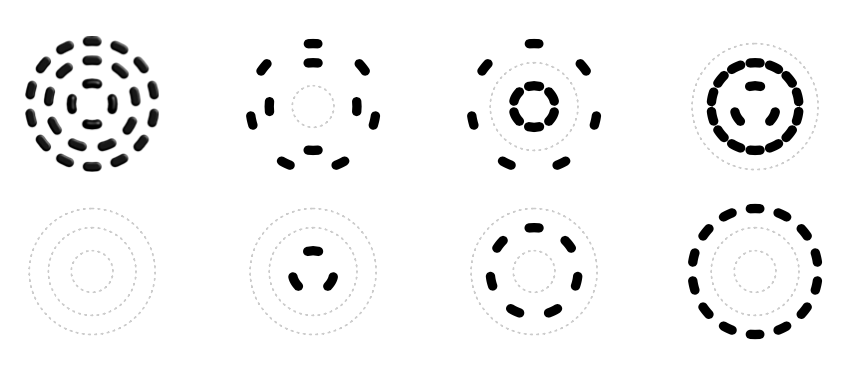
The possible combinatorial configurations of the fundamental semiotic unit make up for 8 possible configurations. By varying which of the three concentric circles carry sign-elements and which remain empty, the system generates a set of distinct structural templates — each distributing information differently across the inner, middle, and outer rings. These configurations could, for instance, accommodate the mapping of core syntactic roles; such as subject, verb, and object (SVO, SOV, VSO, and others) onto specific circles.
Toward Inclusiveness: Phonological Universals and the Articulatory Body
While writing systems and grammatical structures vary enormously across the world’s languages, the human vocal tract is a shared biological substrate. Following the typological work of Ladefoged, Maddieson, and Jakobson, an inventory of eighteen phonemes has been selected — among the most frequently attested cross-linguistically and the most accessible to produce, given the universal anatomy of the articulatory apparatus. This compact inventory serves as a phonological common denominator: not a language that transcends the body, but one that begins from it.
What Remains: Towards a Complete Language
The project is currently focused on the foundational architecture of the conlang, but still needs to address the formulation of a phonotactic system, construction of a morphological framework, development of syntax, creation of a core lexicon, establishment of a semantic and pragmatic framework, and design of writing-to-reading practices. Each of these layers constitutes a domain of ongoing research and experimentation.
The project, as it currently stands, is the result of my individual efforts, reflecting my personal vision and dedication to the development of this conlang. However, I am eager to expand the scope of the project and invite future collaborations. It is my aspiration to engage a multilingual and multicultural team of researchers and/or artists to co-author a research paper that explores the various dimensions of this work. By pooling diverse perspectives and expertise, I believe this can enrich the project’s development and contribute valuable insights to the field of linguistics and visual culture.